No products in the cart.
Shop Now!
Design Thinking
Amanda Lennon – Visual Communications / Interior Designer
Design Thinking is a process I practise and define this process as I grow and develope in my career. Having done some extensive research on this and topic I am so happy to share my findings with you.
It is ‘a way of thinking’, when designing, it applys human-centred techniques to solve problems in a creative and innovative way it can be traced back as far as 1969, Herbert A. Simon’s, also Peter Rowe’s 1987 book Design Thinking, influencing architects and urban planners.
It wasn’t until 1991 that David M. Kelly, founder of IDEO and professor at Stanford University, introduced ‘Design Thinking’ adapting it into the business sector.
As a thinking process, Tim Brown CEO of IDEO in Harvard business review.org, 2008, gives an example of Thomas Edison approach to ‘Design Thinking’, “a methodology that imbues the full spectrum of innovation activities with a human centred design ethos”. (2008, P. 86) Brown says, “Thomas Edison designed the light bulb, and then wrapped the entire industry around it”, (2008, P.85), this was forward thinking of his end result for the consumer. Edison was genius in his ability in his thinking of the entire marketplace, how people would want to use what he made. So he engineered towards that.
Design thinking is a discipline that uses the designer’s sensibility and methods to match peoples needs, with what is technologically feasible and what a viable business strategy can convert into customer value and market opportunity. (hbr.org, 2008, P 86)
Brown also talks about the thinking process in “Designers Think Big” (https://www.ted.com/talks/tim_brown_urges_designers_to_think_big?language=en), how to connect with the consumers’/end user and influence participation rather than design only being used as a tool of consumerism. He says we should take a different view of design focusing less on the object and more on the design thinking as an approach, seeing a bigger impact. It’s about applying the principles of design to the way people work.
He gives an example of Isambard Kingdom Brunel – a civil engineer in the early 1900’s, designing great things with design and innovation. “The Great Western Railway”, named his greatest creation. “He didn’t just want to design the best single train journey, he imagined an integrated transportation system allowing passengers to embark on a train in London and disembark from a ship in New York”. Brown says Brunel was working a hundred years before the design profession emerged but he thinks Brunel was using ‘design thinking’ to solve problems and integrate world changing innovations. In the case of design we need balancing, Desirability – what humans need, with technical Feasibility, and with economic Viability.
Brown says design is human centred. We need to start with Humans, with what makes life easier, more enjoyable, more than ergonomics. Before starting with technology we should start with culture and context, aspirations and the motivations of people.
Brown suggests instead of defaulting to a convergent way of design thinking making the best choice out of available choices, he encourages us to take a more divergence approach to explore new alternatives, ideas, and solutions that haven’t been done before. To help understand Design thinking, it first begins with Rogger Martin a Professor at the business school, University of Toronto with what he calls ‘Integrated Thinking’. The ability to constructively face the tensions of opposing models, and instead of choosing one at the expense of the other, generating a creative resolution of the tension in the form of a new model that contains elements of the individual models, but is superior to each. , https://en.wikipedia.org/wiki/Integrative_thinking
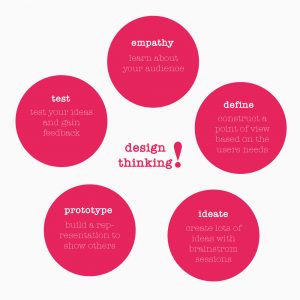
Unleashing the Power of Design Thinking, 2008, an article by Kevin Clarke (Program Director IBM) and Ron Smith (Designer and Brand Strategist IBM), maintain as design professionals you take on leadership roles in a non traditional circumstance, they demonstrate a way to address problems – “leveraging emotional, intelligence, integral intelligence and experimental intelligence”. This offers valuable insight across a diverse range of business activities and decision making. As design thinking is being practised across many industries the principles all remain the same. Design Thinking is extremely useful in tackling problems that are complicated or unknown, by re-framing the problem in a human-centred approach using these five principles below. I hope you enjoyed learning more about design thinking!